What is Map Pack, SERP, NAP & Schema? Plain-English Guide
Charles Anderson
5/17/20266 min read
If you've ever been on a sales call with a marketing agency and felt like they were speaking a different language — "we'll optimize your SERP visibility through schema deployment and improve your CTR in the Map Pack" — you're not alone.
Most SEO agencies talk in jargon. Some do it because they think it sounds professional. Others do it because if you don't understand what they're saying, you can't ask hard questions about whether the work is actually happening.
At Grow Local Flow, we work with small businesses in Jacksonville and St. Augustine — contractors, dentists, restaurants, real estate agents, attorneys, retail shop owners. None of you went into business to learn marketing acronyms. So here's a plain-English guide to the 15 terms you're most likely to hear from any SEO or marketing agency, what they actually mean, and why each one matters for your business.
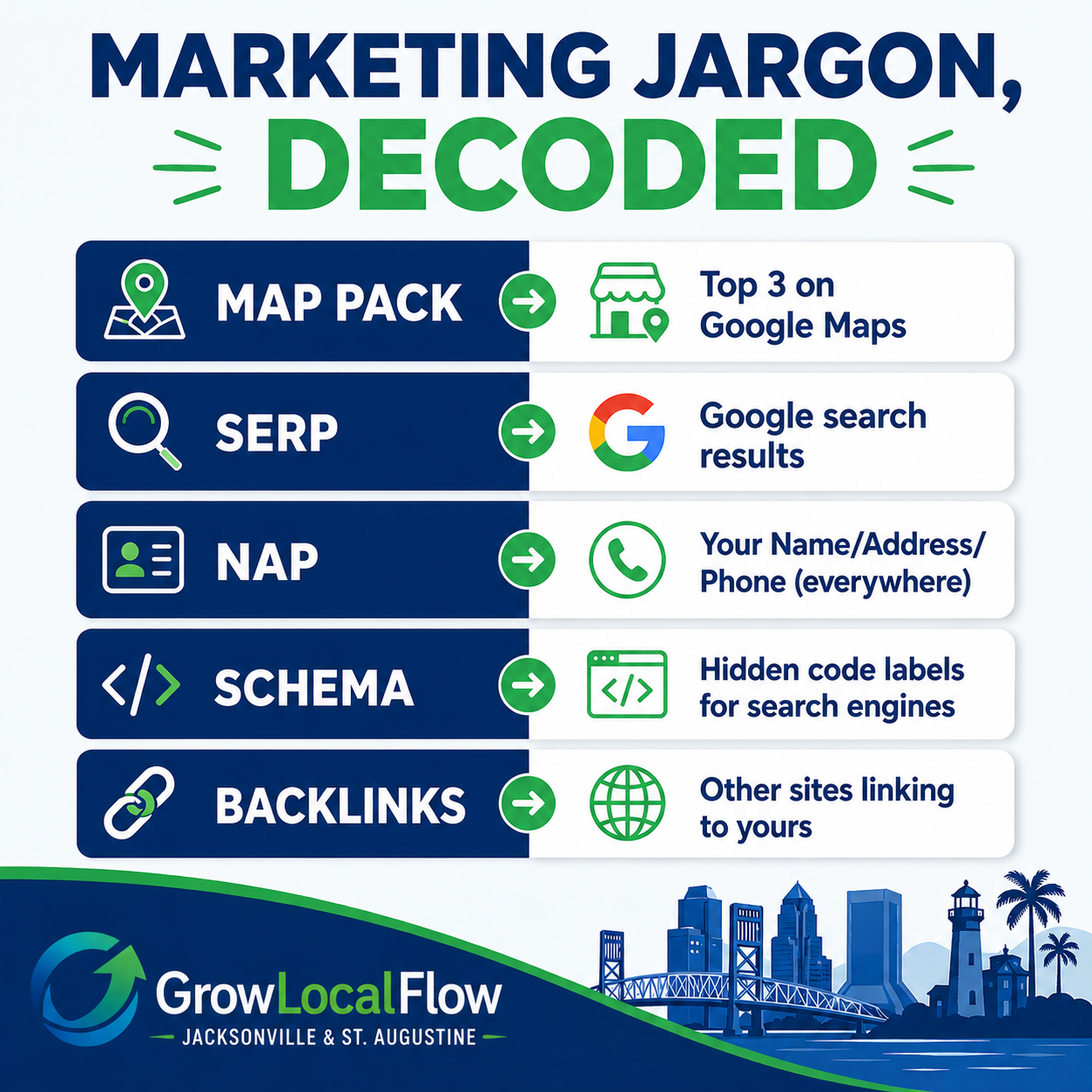
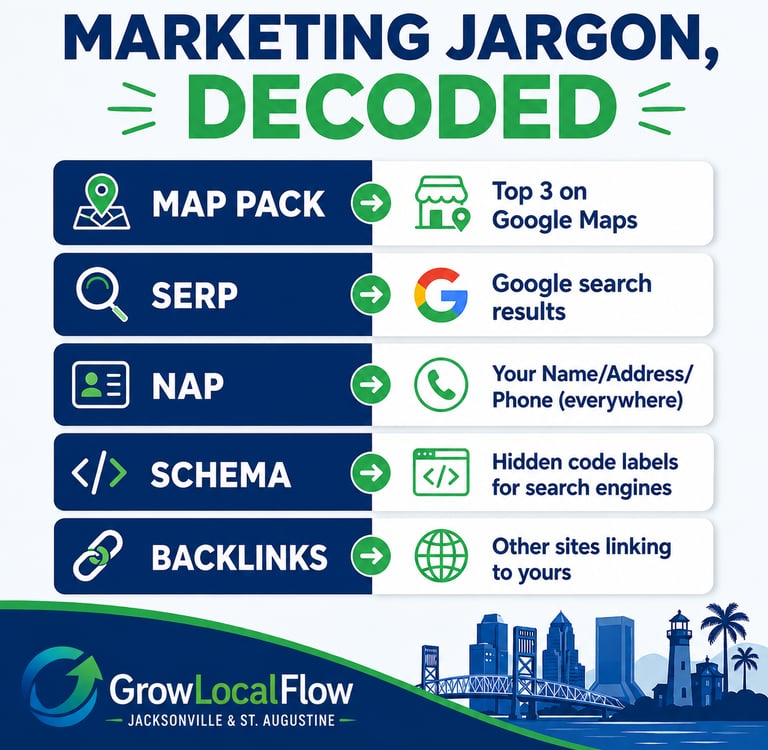
1. Map Pack (also called Local 3-Pack)
What they say: "We'll get you ranking in the Map Pack."
What it actually is: The box of three businesses with a map that appears at the top of Google when someone searches for a local service — for example, "plumber Jacksonville" or "dentist near Mandarin." Those top 3 spots get the majority of clicks for local searches. Getting your business into that box is one of the highest-impact things local SEO can do.
2. Organic Search
What they say: "We'll improve your organic search visibility."
What it actually is: The regular Google search results below the ads. "Organic" just means "not paid." When someone Googles "best HVAC company in St. Augustine" and clicks a result that wasn't marked as an ad, that's organic search at work. The opposite of organic is paid — meaning Google Ads.
3. SERP
What they say: "Your SERP rankings need work."
What it actually is: Just an acronym for Search Engine Results Page — literally, the page of results you see after typing something into Google. If your agency uses this word, they could just say "the search results page" instead.
4. NAP
What they say: "Your NAP needs to be consistent."
What it actually is: Name, Address, Phone number. Specifically, your business's NAP needs to be written identically everywhere it appears online — your website, Google Business Profile, Yelp, Facebook, BBB, every directory. If one site says "Jones Plumbing" and another says "Jones Plumbing LLC" and another says "Jones Plumbing & Drain," Google sees three different businesses and trusts none of them.
5. Schema markup (or just "schema")
What they say: "We'll deploy LocalBusiness schema on your site."
What it actually is: Hidden code on your website that labels what your business is, where you're located, what services you offer, and what your hours are — written in a format Google and AI tools can read clearly. Think of it as a name tag for your website that search engines can scan. Pages with schema get featured more prominently in search results and AI answers than pages without it.
6. Citations
What they say: "We'll build out your citations."
What it actually is: Business listings on other websites — Yelp, BBB, Yellow Pages, Apple Maps, Bing Places, Chamber of Commerce directories, industry-specific directories. Each citation is like a vote for your business's existence and legitimacy. The more (consistent) citations you have, the more Google trusts that you're a real, established business.
7. Backlinks
What they say: "We need to build more backlinks to your site."
What it actually is: Other websites linking back to your website. If the Jacksonville Business Journal publishes an article and links to your business, that's a backlink — and a strong one because the source is trusted. Backlinks are one of Google's oldest and most important signals for figuring out which businesses deserve to rank. Quality matters far more than quantity. One link from a respected local site beats 100 links from spammy directories.
8. CTR (Click-Through Rate)
What they say: "Your CTR is below the category average."
What it actually is: The percentage of people who click on your listing after seeing it in search results. If 100 people see your business in Google search results and 5 click through to your site, your CTR is 5%. A higher CTR means your title and description are more compelling than the alternatives. Improving CTR is often more impactful than improving rank — a #4 result with a strong CTR can outperform a #1 result with a weak one.
9. Conversion Rate
What they say: "Your landing page conversion rate is around 3%."
What it actually is: The percentage of website visitors who do the thing you want them to do — usually filling out a form, calling, or booking. If 100 people visit your site and 3 call you, that's a 3% conversion rate. Most local service websites convert between 2% and 8%; if yours is under 2%, the website itself is leaking customers and needs work.
10. SEM and PPC
What they say: "We can complement your SEO with SEM."
What it actually is: SEM stands for Search Engine Marketing. PPC stands for Pay-Per-Click. In practice, both terms usually just mean "Google Ads." You pay Google every time someone clicks your ad. Useful when you need leads fast (Google Ads can deliver same-day), but expensive long-term compared to building organic rankings.
11. GEO (Generative Engine Optimization)
What they say: "You need a GEO strategy for the new AI search landscape."
What it actually is: Optimizing your business so AI tools like ChatGPT, Perplexity, Gemini, and Google's AI Overviews recommend you when potential customers ask them for help. Increasingly, customers ask ChatGPT "who's the best dentist in Nocatee?" instead of Googling. GEO is the work that gets your business named in the AI's answer.
12. Domain Authority (DA)
What they say: "Your DA is 12. Your competitor's is 38."
What it actually is: A score from 1 to 100 (invented by a company called Moz, not Google) that estimates how strong your website's overall reputation is on the internet. Higher DA generally means a stronger ability to rank for competitive keywords. Most local Jacksonville small business sites have a DA between 10 and 30. Domain Authority builds slowly over years through quality content and quality backlinks.
13. Long-Tail Keywords
What they say: "We'll target long-tail keywords for faster wins."
What it actually is: Search phrases that are longer and more specific than broad terms. "Plumber" is broad. "Emergency plumber Mandarin Jacksonville Saturday" is long-tail. Long-tail searches have lower volume but much higher purchase intent — someone typing the long version is closer to actually hiring. Smart local SEO targets dozens of long-tail phrases, not a single competitive short one.
14. Bounce Rate
What they say: "Your bounce rate is high."
What it actually is: The percentage of visitors who land on your website and leave without clicking anything or visiting a second page. A high bounce rate usually means one of three things: visitors couldn't find what they came for, the page loads too slowly, or the page looks unprofessional. For service business sites, a bounce rate above 70% is a warning sign.
15. Indexing (and "Indexed")
What they say: "Google has not indexed your new page yet."
What it actually is: Google has visited and added your page to its giant catalog of pages it can show in search results. If a page is "not indexed," Google does not even know it exists — so it cannot appear in any search result, no matter how good the content is. New pages typically get indexed within a few days to a few weeks after they're published.
The bigger question: should you have to learn any of this?
Honestly, no. You should be able to hire a marketing agency the same way you hire an electrician or an accountant — describe what you need, agree on the price, and let them handle the work without you needing to memorize the wiring code or the tax law.
But here's the catch with marketing: because there's no licensing, no certification, and no real accountability in the industry, jargon often becomes the way agencies hide whether they're actually doing useful work. If the contract says "monthly SEM and GEO optimization with schema deployment for improved SERP performance," you'll have a hard time evaluating whether you got your money's worth.
That's why we publish this glossary — and why everything at Grow Local Flow comes with plain-English monthly reports that show what we did, what happened to your rankings, how many calls and form submissions came in, and what we're doing next month. Not because we have to, but because that's how we'd want our own marketing partner to communicate with us.
If you're a small business owner in Jacksonville or St. Augustine who has felt lost in agency jargon — or who is currently paying for SEO and isn't sure whether anything is happening — book a free 20-minute call. We'll run real searches on your business in front of you, show you exactly where you rank today, and explain in plain English what's working, what isn't, and what to fix first. No jargon. No sales pitch.
Grow Local Flow, St Johns, FL
Email: hello@growlocalflow.com
Areas served: Jacksonville, St. Augustine, Saint Johns
Copyright 2026, Grow Local Flow